Bookmark and Share
Showing posts with label Journalism. Show all posts

Tuesday, 12 April 2011

“Loyalist Militiaman at the Moment of Death” Robert Capa, Sept’ 5th 1936. [Magnum Photos]

The Spanish Civil War was one of the most important conflicts in the twentieth century, not only because it was the first direct confrontation between the opposing ideologies of Communism and Fascism, but also because it saw the war correspondent become firmly cemented in the public imagination.
Before the war in Spain, war correspondents had been subject to heavy censorship, particularly during the First World War, as well as conflicts such as the Boer War - partly due to the still lingering memories of William Howard Russell’s reports on the Crimean theatre of war. His reports on the conditions of the British expeditionary force’s and the fighting they took part in shocked the public to the point of causing the fall of the then government.
When General Francisco Franco’s insurgent forces waged war on the Spanish government, The League of Nations remained neutral and the Western European powers such as Britain and France declared that they would not intervene despite the Fascist nations of Italy and Germany providing overt support for Franco. As a result of ‘Non-Intervention’, censorship in the popular press was not the problem it had been in previous conflicts and many Journalists flocked to Spain in order to cover the conflict and support the ideologies they believed in, and for the first time the horrors of a deeply divisive conflict were reported as they unfolded at the front.
Spain became the crucible for modern war correspondents - George Orwell, Ernest Hemingway, and Martha Gellhorn were constantly amongst the republican troops and the populous of cites like Madrid and Barcelona. While Robert Capa forged the iconic role of the photo-journalist by capturing classic shots of the loyalist armies, and companies such as Pathé News inc. produced newsreels of actual footage rather than the previously staged footage of the great war.


The Western Journalist in Spain
The three names most synonymous with the coverage of the Spanish Civil War in the western media are George Orwell, Ernest Hemmingway, and Martha Gellhorn who‘s Essays, Journalism, and in the case of Hemmingway, Fiction, have all become the best known accounts of the conflict in the Western world.
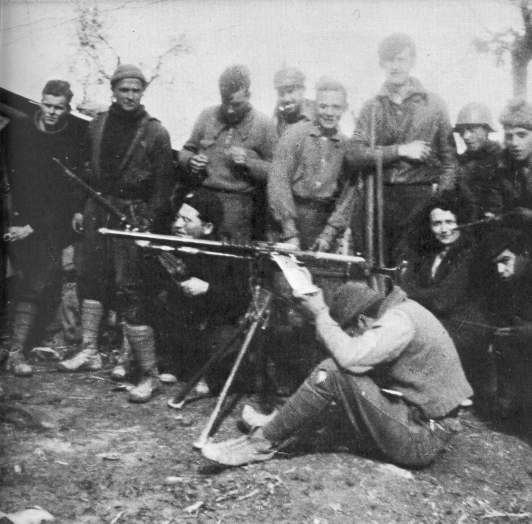
George Orwell (back row, 3rd from right) with the P.O.U.M, 1936. [Hoover Institution Archives]

Despite not being an active war correspondent during the Spanish Civil War, Orwell’s reportage Homage to Catalonia paints a vivid account of the writer’s experiences, not only amongst the Marxist militias on the frontline against Franco, but also of the complicated political in-fighting that plagued the republican side. These experiences had lasting effects on Orwell who wrote in a letter to his friend Cyril Connolly "I have seen wonderful things and at last really believe in Socialism, which I never did before" 1 Orwell was wounded in the throat by a sharpshooter while at the front and shortly after his recovery had to leave Spain due to the forceful dissolution of the militia armies in favour of the international brigades. Upon returning to Britain Orwell was angered by both the left-wing press as well as the right for their continued distortion of the truth of the conflict he’d seen first hand - in New English Weekly in 1937, he wrote:

“…in spite of all those hecatombs of nuns who have been raped and crucified before the eyes of Daily Mail reporters, whether it is the pro-Fascist newspapers that have done the most harm. It is the left-wing papers, the News Chronicle and the Daily Worker, with their far subtler methods of distortion, that have prevented the British public from grasping the real nature of the struggle.” 2

Though Orwell is mostly identified with the last two great works of his life Animal Farm, and Nineteen Eighty-Four, it was his work as a journalist that he was known for during his life, and it was most certainly his reportage on the civil war that made his name as a polemic voice of dissent in the popular media. It was this sense of conviction, forged on the frontline of the Spanish Civil War, and so brutally re-assessed during the political upheaval in the republican side that followed, that planted the seeds of what would become his chilling vision of a future that still hangs over us today.

Hemingway (Center) in Spain, 1937. [jfklibrary.org - Public Domain]

Ernest Hemmingway’s most lasting commentary on the Spanish Civil War is the novel For Whom The Bell Tolls which follows the real events of the war through the personal experiences of an American named Robert Jordan, who fights for the Spanish Republic. While in Spain, Hemmingway wrote his reports for the North American Newspaper Alliance about the conflict. He would often turn a blind eye to any reports of atrocities committed by republican forces, and went so far as to lend his voice to the 1937 propaganda film The Spanish Earth. In a letter written to Carlos Baker in 1951, 11 years after the publication of For Whom the Bell Tolls, Hemingway wrote that “Politically, I was always on the side of the Republic from the day it was declared and for a long time before."3
Hemingway’s journalistic accounts of the action throughout the conflict are visceral in their descriptions, particularly in his reports of the shelling of Madrid, that was to secure the true horrors of war in the minds of his readers. His lexicon is technical and militaristic, yet the scenes described recall the literary flair seen in his short fictions that blurred the lines between reporting and literary narrative, such as in this dispatch during the siege of Madrid:

“During the morning twenty-two shells came into Madrid. They killed an old woman returning home from the market, dropping her in a huddled black heap of clothing, with one leg, suddenly detached, whirling against the wall of an adjoining house.”4

Hemingway’s obsession with all things Spanish had begun in the late twenties when he first experienced the spectacle of Bull fighting. But it was his civil war experience that was to drastically effect not only his political and religious beliefs for the rest of his life, but also go on to effect the world view of the next generations with For Whom the Bell Tolls - securing the sacrifice for the second Spanish Republic as the last great noble cause in the minds of many people around the world.

Gellhorn in Spain, 1937(?) [jfklibrary.org - Public Domain]

Martha Gellhorn is perhaps, one of, if not the most important war correspondent’s of the twentieth century, having reported on nearly all the major world conflicts that took place during her journalistic career. During the Spanish Civil War, she was employed by Collier’s Weekly to provide accounts of the conflict. Where Orwell’s experiences in amongst the P.O.U.M had turned him against Communism (particularly the kind the featured Stalin as it’s figurehead), Gellhorn’s experiences documenting the progression of the war alongside Hemingway would lead her to remain a supporter of the Stalin-backed republican government for the rest of her life - in a BBC radio four interview she said “There was a conviction that Fascism was a horrible and bad thing, and that this was the place to be to fight it. And it was an absolutely unbelievable, noble kind of experience.” 5
Gellhorn’s journalistic output was more geared towards reports on the daily life of the people of Spain, particularly those in the besieged capital of Madrid. She conveyed the humanitarian impact of the conflict and has since been described as technically similar to Hemingway‘s dispatches, but more powerful because of their human interest angles - as in this extract from a dispatch written during the siege of Madrid two month’s after the previous one by Hemingway:

“Later, you could see people around Madrid examining the new shell holes with curiosity and wonder. Otherwise they just went on with their daily routine of their lives, as if they had been interrupted by a heavy rainstorm but nothing more”6

Gellhorn’s influence on war reporting not only made it acceptable for women to become correspondents, but also to look at the events of war from the point of view of the people they effected. In Hemingway’s dispatches the casualties of war were a matter of fact, but in Gellhorn’s the human suffering of the conflict elicited an empathic response in her readers that as a journalistic device is used today in combination with television footage of the people themselves.

The coverage of Orwell’s reportage and essays, Hemmingway’s dispatches and fiction, and Gellhorn’s humanitarian angles on the conflict, have all come together to form what we see as modern war reporting in all journalistic mediums. Before the Spanish Civil War, never had a conflict been covered from the point of view of the front line fighter, or non-combatants but now reporters embedded with troops and ‘real life under fire’ reports are now the staple of modern conflict coverage.

END

1469 Words


End Notes:
1 Sedgwick, P. George Orwell International Socialist? (1969) (http://marxists.org/archive/sedgwick/1969/orwell)

2 Orwell, G. Spilling the Spanish Beans. (1937) New English Weekly (http://netcharles.com/orwell/essays/Spanish beans)
3 From the Hemingway Collection quoted on http://www.archives.gov/publications/prologue/2006/spring/hemingway.html
4 Hemingway, Ernest. N.A.N.A Dispatch: 11 April 1937. White, William (Ed). By-Line: Ernest Hemingway (1970) London: Penguin Books. P. 2495
BBC Radio Four Interview with Nigel Ford. Bookshelf, 4th January 1990. (http://www.bbc.co.uk/bbcfour/audiointerviews/realmedia/gellhornm/gellhornm3.ram)
Gellhorn, M. High Explosive for Everyone, July 1937. From The Face of War (1998) London, Granta Books. P 21.


Releated Links:
http://en.wikipedia.org/wiki/Spanish_Civil_War
http://www.timesonline.co.uk/tol/system/topicRoot/The_Spanish_Civil_War/
http://www.netcharles.com/orwell
http://www.marxists.org/
http://blip.tv/file/413638/
http://blip.tv/file/413689/
http://www.pbs.org/wnet/americanmasters/database/capa_r.html
http://www.britishpathe.com/product_display.php?searchword=spanish+civil+war
http://www.magazinesandwar.com/en.html
http://orpheus.ucsd.edu/speccoll/swphotojournalism/
http://www.magnumphotos.com/Archive/C.aspx?VP=XSpecific_MAG.PhotographerDetail_VPage&l1=0&pid=2K7O3R14YQNW&nm=Robert%20Capa
http://www.newsreelarchive.com/
http://en.wikipedia.org/wiki/Ernest_Hemingway#Spanish_Civil_War
http://en.wikipedia.org/wiki/Martha_Gellhorn
http://www.bbc.co.uk/bbcfour/audiointerviews/realmedia/gellhornm/gellhornm3.ram
http://www.salon.com/media/1998/03/12media.html
http://www.ernesthemingway.org.uk/

Sunday, 20 February 2011

Another old piece from my MA work. This was, in fact, just a small part of a wider essay that I wrote to accompany a portfolio of webzine articles. I have therefore now edited and expanded upon it certain places in order to round it off. I'm posting it in the blog for the future, and hope somebody may yet find it useful... even if they just fish the quotes out of it.


Writing content for online publication shares many of the same key skills as traditional journalism insomuch as the content must be relevant, written in a dynamic and easy to follow manner, and correctly formatted for the medium of publication. The Jennifer Kyrnin article, ‘10 Tips For Good Web Writing’ published on About.com, breaks these down into a list of ten easy to remember rules:

  1. Write relevant content.
2. Put conclusions at the beginning.
3. Write only one idea per paragraph.
4. Use action words.
5. Use lists instead of paragraphs.
6. Limit list items to 7 words.
7. Write short sentences.
8. Include internal sub-headings.
9. Make your links part of the copy.
10. Proofread your work.1

However the first major difference between writing for print and the web is in the formatting of the articles. As in traditional journalism, style guides differ from publication to publication depending on the audience it caters for but many web-based publications today will have accessibility on a global scale in mind. For example, MSN news will keep the sentences short, with one idea per paragraph, use contextual hyperlinks and include sub headings in bold and italic type. The logic behind keeping the style simple and the format easy to navigate is due to articles on a screen being harder to read, and according to the London School of Economics website:

“People who use the web do not behave like people reading a book. They are usually looking for specific information. Web authors must make it easy for them to find what they want.
Studies show that people read online text a lot slower than printed text. Reading from a screen for an extended period of time is generally an unpleasant experience for most users.”2


When taking this into account we can see a definite gap begin to emerge between the styles of the articles written for print and the web. For instance, in the daily newspaper The Independent on the 14th of August 2010, the article Not stopping at the next station – there's no driver, about a runaway maintenance train on the London Underground was featured. On the MSN UK news website, an article on the same subject appeared titled Tube line cleared due to runaway maintenance train. The first major difference is visible in the titles themselves. The Independent article is ambiguous and draws you in, whereas the MSN article is immediate and full of information. One reason behind this is what is known as Search Engine Optimisation – the practice of including certain keywords in articles in order to gain listings in search engines such as Google. Another reason according to Jakob Nielson is that:

“In print, you can spice up linear narrative with anecdotes and individual examples that support a storytelling approach to exposition. On the Web, such content often feels like filler; it slows down users and stands in the way of their getting to the point.”3

This example is best illustrated by the opening paragraphs to each article. In The Independent the opening paragraph is a sentence containing a brief summary of the story with little information yet it uses dramatic words such as “Chaos” and “Hurtled” to peak the reader’s attention.

“A runaway train brought chaos to London Underground yesterday as it hurtled through six stops on the Northern line.”4

However in the MSN article we can immediately see that there is significantly more information included in the opening paragraph, although the overall length of the sentences doesn't differ by much.

“A runaway train went through six stops on a 13-minute journey on the Tube on Friday with other Underground trains having to be cleared out of its path.”5

Another area where web journalism differs from print is in the presentation of articles, which differs significantly in many areas. The principle formats for print articles are broken down into three categories; News, news in brief and features. For online journalists the formats can include these and sub-sections thereof. For instance a feature may be included amongst a web of articles that are connected by hyperlinks. It may be broken down into galleries with photographs providing the lead ins. Audio and video may also be included to give more contextual background and interactivity that doesn't detract from the conciseness of the text. According to Robert Niles, writing for‘The Online Journalism Review, the opportunity is also there to utilise other formats than the web article to create a rapport with the reader by crafting an article that will create a discourse between the writer and the audience.

“Online writers can communicate with their readers in many more forms than the traditional news article. Blogs, ‘Wikis’ and discussion boards dissolve the barrier between writer and reader, creating a more informal and interactive writing environment. Take advantage of this opportunity and distinguish yourself by writing in a clean, active, conversational style that will make your readers feel as comfortable reading your words as they feel when talking with a close friend.”6

Many publications do operate both print and web services; The Independent, for example, includes all the articles available in it's newspaper and magazines and re-prints them on the website. These articles remain unchanged from the way they appear in print form, but are incorporated into the web layout with links to similar articles within the website. This is a common practice among magazines and newspapers that were published in print before adding a digital wing as well. This has the benefit of making the content from previous editions of the publication archival and allowing people, who didn’t purchase the physical copy in time, to go back and find articles.

However some publications have begun to switch over to purely digital content and as such have archived their print editions as pictures in JPG, PDF or Flash formats. These differ in effectiveness as to the search-ability of the content on the web as search engines do not as easily index JPG and Flash files as they do a PDF file. This has led some web publications to also create downloadable PDF versions of their articles as an electronic publication (E-Zine etc.) which can either be sold for a nominal fee or downloaded free of charge. Provided the downloader has a portable computer or tablet to view the document on they no longer need to be connected to that site to view the content.

The final difference is speed. Although a news site may receive a story from the same source as a newspaper, the speed at which they are published differs greatly. A news site like BBC online compared to The Independent can break news within an hour or so of it happening, if not instantly. This is due to the speed at which content is written, checked and published. This is why an initial report will often be short and sketchy on the details, and followed up with several more to clarify things, which is not dissimilar from the way modern rolling TV news operates. As a blog or webzine publication most news will be broken from a press release or taken second hand from another news source. These lead to a lot of repetition on sites as contributor’s copy and paste press releases or directly quote large chunks of other stories in an attempt to break news quickly.
In stark comparison newspapers and magazines may have to wait up to between a day and even a month before the same story can be published. This therefore gives them more time in which to be able to write original content and allow for more clarified information to come through before committing to publication.


With major publications invested in digital content, and new magazines, journals and newspapers increasingly opting for a web or other electronic platform to reach more readers, it is safe to assume that web writing is a skill that all journalists will need in their arsenal in the future. Newly qualified journalists will also have to have an increasing awareness of not only web writing, but also in the construction of websites. Basic skills such ass hyper linking, creating and adding pictures and graphics to HTML will all be part and parcel of prepping articles for publication. That is of course barring the irreversible collapse of the Internet overnight.


End Notes:
1 Kyrnin, Jennifer. 10 Tips For Good Web Writing. (webdesign.about.com/od/writing/a/aa031405.htm)
2 Writing For The Web. (www.lse.ac.uk/resources/webEditorsHandbook/bestPracticeGuide/editorialWriting/writingForTheWeb.htm ) 2009
3 Nielson, Jacob. Writing Style For Print Vs Web. (www.useit.com/alertbox/print-vs-online-content.html ) June 2008
4 Woodman, Peter. Not stopping at the next station – there's no driver. Independent (London), Saturday 14th August 2010. pp 11.
5 Tube line cleared due to runaway maintenance train. (news.uk.msn.com/articles.aspx?cp-documentid=154392333), Saturday 14th August 2010.
6 Niles, Roberts. How To Write For The Web. OJR: The Online Journalism Review (www.ojr.org/ojr/wiki/writing/), March 2008.

Saturday, 22 January 2011

I haven't added a serious article to the blog in a long time so here is one. It was originally part of my Masters portfolio that accompanied the Tor Marrock interview that has since been published on http://www.reflectionsofdarkness.com/. There was also a feature on concert photography done in the style of Digital SLR Magazine which I may post as well at some point.
The following is a report rather than an essay, and I have slightly expanded a couple of points and added pictures to make it an easier read.
Enjoy.


Neue Zeitschrift für Musik issue #35


Music journalism is agreed to have started as soon as the popular press (newspapers and journals), as we recognize it, came into circulation in the eighteenth century. The reporters and reviewers employed then were often professional musicians themselves such as Robert Schumann who founded the journal Neue Zeitschrift für Musik in 1834. At this time the subjects of the reportage and criticism were mainly operas and symphonies with “lower” forms of music such as traditional folk music, monastic music and vaudeville being regarded as common and not of interest to the upper class readers. This changed during the period of the Romantic Movement when interest in music became much more widespread and non-specialist publications began to cover more entertainment subjects with journalists who were not necessarily experts in the field.

Coverage of rock‘n’ roll and pop music as we know it today didn’t become widespread until the early 1960’s after the international success of The Beatles. At this time publications such as Melody Maker, Sounds, The NME, and Rolling Stone emerged ― sometimes first as small circulation fanzines, then as established publications. As John Harris wrote for The Guardian in 2009:

“The history of rock writing begins around 1966 when, with what was once mere "pop" being taken seriously, the American writer Paul Williams published a journal-cum-fanzine titled Crawdaddy, which aimed to bring to rock music the kind of cerebral writing long devoted to folk and jazz. Other currents were swirling around the more educated bits of the US counter-culture, among them the expressive precedents set by the Beats and the possibilities suggested by New Journalism.” 1

These new magazines not only covered and critiqued the artists and their output but also began to dictate the changes in music trends in. So much that Rolling Stone magazine began courting power with record labels for the public attention a cover feature could generate for a band. Music journalism soon became big business as cover features in influential publications came to be seen as stepping-stones for musical acts and their record labels.


In the 1970’s music journalism took its first steps back toward being controlled by the people as much as the wider media. In 1976‘punk’was, according to the late Malcolm McClaren, born and with it came the new wave of fanzines. This was a backlash against the commercialised and increasingly impenetrable world of mainstream music coverage that allowed fans of new genre’s such as punk to write articles and reviews and publish them via their nearest Xerox copier. One notable example, and for some the original punk fanzine, was Sniffin’ Glue by Mark Perry. The cut and paste 'DIY' nature of this fanzine soon spread and became a platform for writers such as Danny Baker, Mick Mercer and Tony Fletcher who would in the following years of the 1980’s take control of the established publications.


Sniffin' Glue issue #3 featuring The Damned


The punk ethic that was carried over from the scene’s fanzines into mainstream magazines such as The NME and Melody Maker in the 1980’s shook up the established idea of music writing. Critique and reportage had been the objective of the magazines for their entire lifespan thus far. But with the new wave of writers came the new wave of attitude. Tom Wolfe's "New Journalism" and Hunter S. Thompson's "Gonzo" styles incestuously mixed with deconstructionist literary theory and frank, opinionated personalities. Take for example this review of the Bauhaus single‘The Passion of Lovers’from The NME by Adrian Thrills, which simply states:
“The desperation of losers…”2

The idea of the music journalist as a somewhat glamorous entity who travelled the world to do drugs with bands and write about it wasn’t a new one ― Just ask former NME scribe Nick Kent. However the idea of a music journalist that told you that you were an idiot for liking a certain band or, more often, and idiot for not liking them was more novel. As Everett True recently summed up his late colleague Steven 'Swells' Wells as the “paradigmatic tastemaker critic”:


“[T]aste-maker critics are like gods […] Do the public really require―or even want―a faceless “meta” critic, the lowest common denominator of countless opinions, where all opinion is reduced to a mean average mark?”3


The late Steven 'Swells' Wells: "Tastemaker Critic"


This style of music journalism has since been mythologised in the popular consciousness. Across the Atlantic in the USA, Lester Bangs was pioneering his own brutally honest form of music journalism that initially found a home in the pages of Rolling Stone magazine and later Creem. Bangs' cerebral and incendiary style was again informed by the principles of "New Journalism" and "Gonzo" which has given his thirteen year career an "outsider" credibility. This has even led to him being portrayed in Almost Famous (2000) as a wise guru and mentor to the film's young and naive protagonist.

"Well basically I just started out to lead [an interview] with the most insulting question I could think of. Because it seemed to me that the whole thing of interviewing as far as rock stars and that was just such a suck-up. It was grovelling obeisance to people who weren't that special, really. It's just a guy, just another person, so what?" 4


Lester Bangs: Journalist with attitude.


The weekly music publication in the 80’s was transformed, taking the idea of artistic writing and running with it with many publications opting to take the reader into the discussion by engaging with them. The reader may not necessarily like what the writer has to say, but based on their experience of that writer's work they will have formed their own opinion. As a result the reader will be able to create further discourse because of it. Thus spreading the debate and keeping the sense of ‘fanzine-people-power’, as Petra Davies notes:
“This model’s imagined reader is willing to become engaged with what she reads, a participant by proxy in the cut and thrust of art-criticism, and, crucially, imagined as likely to disagree as to agree.”5

Suddenly the music press made a dramatic shift in the 90’s. The glossy monthly magazine grew as the format of choice and with it an objective ‘consumer review’ style of writing that reduced the artistic merit of albums to the level of the machines that played them. The mainstream music press systematically alienated those who had personally invested in it. The idea of a balance between a trustworthy rating system and writing that would attract more advertising became the basis for a new type of marketing system. The authoritative and sometimes incendiary critic was, as a result, toned down if not snuffed out altogether.

As the world-wide-web grew and connected to more homes in the late 1990s, the fanzine began to return to strength through the basic HTML coding of websites. Companies such as Geocities, Angelfire, and Lycos provided free web space and a ‘drag and drop’ interface that gave people the chance to create their own E-Zines. By the turn of the millennium E-Zines had become as slick as the mainstream print publications, but were not yet bound by the same rules. Advertising came, but not enough to qualify censoring the opinions of its critics. Many sites even featured forums where the readers could praise and blast the reviewers, or even do some of their own reviewing thus continuing the trend of stimulating debate into the digital realm.


The shift to web 2.0 has since provided even more scope for the websites. Wordpress and Joomla have become powerful content management systems that promote user interaction (and best of all they are free!). Cheap web space and domain names coupled with the explosion in professional and amateur blogs has created a system of critics on the pulse of the industry that has propelled bands into the mainstream media’s attention.
“A counter-culture of laptop-toting aural misanthropes has successfully (if not accidentally) managed to turn the music industry on its head. Suddenly indie is not so “indie,” and the counter-culture―like it or not―is not so “counter.” Ironically, the citizen journalism cult built on P2P file sharing and hipster snarkiness is driving the music business, not draining it.”6

The falling circulation of publications and decreasing revenues in recent years has meant that many titles have begun to switch over to the interactive and blog-based webzine format. In many cases using the website portion of the publication to compliment, enhance and sell the traditional print version. But is it too late for the mainstream media model in the face of digital expansion, or will the bloggers of today like the fanzine writers of the punk era, take over the current publications and shift focus once again?


 End Notes:
1. Harris, John. The Guardian. http://www.guardian.co.uk/music/2009/jun/27/music-writing-bangs-marcus  (June 2009)
2. Thrills, Adrian. New Musical Express. (4th July 1981), P31 - Full review.
3. Davis, Petra. Drowned in Sound. http://drownedinsound.com/in_depth/4137396  (16th July 2009)
4. DeRogatis, Jim. Perfect Sound Forever. http://www.furious.com/Perfect/lesterbangs.html (Nov 1999)

5. Davis, Petra. Drowned in Sound. http://drownedinsound.com/in_depth/4137396  (16th July 2009)
6. Wayne, Jim. Online Journalism Review. http://www.ojr.org/ojr/stories/071218wayne/  (18th December 2007)
 

Imago Alchemae: Imago Mortis on Tumblr

 
Twitter Facebook Tumblr Flickr Red Bubble