Bookmark and Share
Showing posts with label spanish civil war. Show all posts

Sunday, 15 May 2011

“All issues are political issues”

* * * *
I aim to look through the Journalistic work of George Orwell and apply the quote in the title to the development and expression of his political voice in his writing.

1. Pre-Spain: The Disillusioned Imperialist Empathising with the Working Class.
2. Spanish Civil War: The Forging of Orwell the Socialist.
3. Post-Spain: The Voice of Dissent in the Popular Press.

* * * *

By the time Animal Farm was published in 1945, Orwell was in poor health, and despite keeping up his Journalistic output until his death five years later from Tuberculosis, the last few years of his life were geared towards the creation of his master work Nineteen Eighty-Four. Prior to this Orwell was chiefly identified as the literary editor of the Tribune, as well as a contributor to several other major media publications including The Observer, Manchester Evening News, and a one time producer at the BBC. Before the Second World War he’d made moderate stirs in the world of book writing with his Novel ‘Burmese Days’, but it was his books of reportage amongst the lower echelons of society Down and Out in Paris and London, and The Road To Wigan Pier that literary people would have known him for.

1. Orwell’s upbringing was typically ‘Lower-Upper-Middle Class’ as he put it. He was born in Imperial India and was educated at Eton before joining the Imperial India Police. After five or so years in the force Orwell grew disaffected with the Imperialist machine as a whole and resigned from the police while on leave in England. He then embarked on a life of self-imposed poverty and writing, the experience of which would become his first published book, Down and Out…. In 1929 he came to the attention of the British secret service who wrote in the file the kept on him until his death, in which Orwell is described as follows:

"This man has advanced Communist views, and several of his Indian friends say that they have often seen him at Communist meetings. He dresses in a bohemian fashion both at his office and in his leisure hours." - MI5/6 File on Eric Arthur Blair from 1929-1952, released in 2007. 1

Despite what is written here, Orwell wasn’t as politically inclined in his writing as first thought. Orwell had a deep sense of social justice that resonated through his writing, and through his fascination and close contact with the working classes, he developed an empathy with their plight.

“Beggars do not work, it is said; but, then, what is work? A navvy works by swinging a pick. An accountant works by adding up figures. A beggar works by standing out of doors in all weathers and getting varicose veins, chronic bronchitis, etc. It is a trade like any other; quite useless, of course—but, then, many reputable trades are quite useless.” 2

In part two of The Road to Wigan Pier Orwell describes what he defines as a socialist:

"A real Socialist is one who wishes - not merely conceives it as desirable, but actively wishes - to see tyranny overthrown"3

The Road to Wigan Pier sees Orwell observe the working class inhabitants of the northern towns and cities he visits, and though he attends Socialist meetings he also attends Black Shirt meetings which reinforces the observational and detached political nature and remains merely sympathetic to the struggles of the left and therefore one of those who “merely conceives it desirable”.

2. In 1936 an army Insurrection led by General Franco rose up against the legitimate Republican government of Spain, and the socialist state was plunged into a bitter Civil War. Franco was openly backed by the Fascist governments of Hitler and Mussolini while countries such as Britain signed a pact of non-intervention. Streams of working class men and women flowed into Spain from different countries in order to defend the ideals of socialism… and amongst them was Orwell. It was here that Orwell the socialist was created - a letter written in Barcelona in 1937 to his old Etonian friend Cyril Connolly, Orwell claimed that:

"I have seen wonderful things and at last really believe in Socialism, which I never did before" 4

In the first chapter of Homage to Catalonia, Orwell records his initial motivation and his reasons for joining the conflict:

“I had come to Spain with some notion of writing newspaper articles, but I had joined
the militia almost immediately, because at that time and in that atmosphere it seemed
the only conceivable thing to do.” 5

The Spanish Civil War would become the conflict that would create the true voice of George Orwell that would become so apparent in his later journalism and ultimately in his chilling warning of the world to come. Orwell’s experiences first hand of life in the P.O.U.M revolutionary militia sandwiched between Franco’s Nationalists and the ruling Stalin-backed communists would deeply affect his world view post 1938. In the essay Orwell’s Spanish Experience, Anders Iversen states that:

“He [Orwell] knew, at least a few months later when he was writing about this period, that his Spanish experience was the interregnum of his life, something extra-ordinary (the setting, the strangers and foreigners, the war, the isolation).” 6

After fleeing Spain and returning to England only to find himself a political leper due to his P.O.U.M connections, the focus of his anger was directed towards the media that engineered the distorted view of the conflict through their self-serving propaganda.

“THE SPANISH WAR has probably produced a richer crop of lies than any event since the Great War of 1914-18, but I honestly doubt, in spite of all those hecatombs of nuns who have been raped and crucified before the eyes of Daily Mail reporters, whether it is the pro-Fascist newspapers that have done the most harm. It is the left-wing papers, the News Chronicle and the Daily Worker, with their far subtler methods of distortion, that have prevented the British public from grasping the real nature of the struggle.”
- New English Weekly, July & September 1937 7

3. Orwell’s Journalistic output from this point on becomes polemic and fervent in its quest for truth, often saying things that people did not want to acknowledge - his literature would also be affected by this (i.e. Animal Farm was written while the soviets were our allies and therefore published after the war, but at a time when the cold war was coming into focus which helped it in the long run). In the confessional essay Why I Write Orwell states that:

"Every line of serious work that I have written since 1936 has been written, directly or indirectly, against totalitarianism and for democratic socialism, as I understand it." 8

Orwell vocalised his ideas in his essays and articles that continued to be published throughout the war by various publications, but none more so than in his column As I Please published in the Tribune. In this extract he observes that the word ‘Fascist’ has come to be nothing more than a swear word of little meaning in the minds of the people, in no doubt partly due to media propaganda.

“It will be seen that, as used, the word “Fascism” is almost entirely meaningless. In conversation, of course, it is used even more wildly than in print. I have heard it applied to farmers, shopkeepers. Social Credit, corporal punishment, fox-hunting, bull-fighting, the 1922 Committee, the 1941 Committee, Kipling, Gandhi, Chiang Kai-Shek, homosexuality, Priestley’s broadcasts, Youth Hostels, astrology, women, dogs and I do not know what else.” 9

This quote is also a good example of what is meant by Julian Symon’s observation about Orwell’s As I Please which was written originally as a postscript for an edition of Nineteen Eighty-Four.

“Some of these pieces were seriously conceived, others were week-to-week journalism, but all of them showed an idiosyncratic freedom in putting down things that interested him, often combined with a previously unsuspected humour.” 10

Orwell’s writing - particularly during the post-Spain period - is marked by common sense and delivered in a manner so as to be academically sound, and yet accessible to the everyday reader. Integral to Orwell’s journalistic and literary voice, and the primary reason for his longevity since his death is the way he wrote his ideas down. Orwell had said that originally he wanted to make very descriptive books, but ultimately he became the celebrated voice of clarity.

"He was a master of lucidity, of saying what he meant, of exposing the falsity of what he called double-think"11

"[Orwell] was the finest journalist of his day and the foremost architect of the English essay since Hazlitt."12

It was this style of journalism that ensured his position within the popular press even though he often spoke out against them in his own work.


The development of Orwell’s political voice is tied into the experiences he endured during the Spanish Civil war. It was during this time that we see a marked change between Eric Arthur Blair expressing sympathy for the people he encountered, to George Orwell truly championing the cause in print.

“When I sit down to write a book, I do not say to myself, ‘I am going to produce a work of art’. I write it because there is some lie that I want to expose, some fact to which I want to draw attention, and my initial concern is to get a hearing.

[…] “And looking back through my work, I see that it is invariably where I lacked a political purpose that I wrote lifeless books and was betrayed into purple passages, sentences without meaning, decorative adjectives and humbug generally.” - Why I Write (1946) 13

Orwell’s post Spanish Civil War journalistic output shows a man who has developed his own strong political view and desire to expose the truth as he sees it even when it is unpopular and polemic to do so. It is the post-Spain Orwell that creates the final political statement of Nineteen Eighty-Four, a statement that contains no traces of the pre-1936 Orwell as described previously.


1 http://www.mi5.gov.uk/output/communists-and-suspected-communists-3.html (2007)


2 Orwell, G. Down and Out… (2003) New Edition. London: Penguin Classics. Chapter 31

3 Orwell, G. The Road to Wigan Pier. (2001) New Edition. London: Penguin Classics. Chapter 13

4 Sedgwick, P. George Orwell International Socialist? (1969) (marxists.org/archive/sedgwick/1969/orwell)

5 Orwell, G. Homage to Catalonia. (2003) New Edition. London: Penguin Classics. Chapter 1

6 Iversen, A. Something To Believe in… (1988) University of Aarhus & Skelos. Chapter 1

7 Orwell, G. Spilling the Spanish Beans. (1937) New English Weekly (netcharles.com/orwell/essays/Spanish beans)

8 Orwell, G. Why I Write. (1946)

9 Orwell, G. As I Please - What is Fascism?. (1944) London: Tribune. (georgeorwell.t35.com/As%20I%20Please/24_March%20_1944.pdf)

10 [Symons, J quoted in] Crick, B. Orwell: A Life (1992) London: Penguin. Chapter 14.

11 Smith, M S [Quoted on] www.mantex.co.uk/ou/a319/orwell-1.htm

12 Howe, I [Quoted on) www.george-orwell.org/l_biography.html

13 Orwell, G. Why I Write. (1946)

 
Bibliography


Orwell, G. Down and Out… (2003) New Edition. London: Penguin Classics

Orwell, G. The Road to Wigan Pier. (2001) New Edition. London: Penguin Classics

Sedgwick, P. George Orwell International Socialist? (1969) http://www.marxists.org/archive/sedgwick/1969/xx/orwell.htm (From International Socialism (1st series), No.37, June/July 1969, pp.28-34.)


Orwell, G. Homage to Catalonia. (2003) New Edition. London: Penguin Classics.

Iversen, A. Something To Believe in: Writers Responses to the Spanish Civil War (1988) University of Aarhus & Skelos.

Orwell, G. Why I Write. (2004) Great Ideas Edition. London: Penguin Classics.

Crick, B. Orwell: A Life (1992) London: Penguin.

George Orwell Links (1995-2009) Canada: www.netcharles.com/orwell/

George Orwell Eric Arthur Blair (2009) Canada: georgeorwell.t35.com/

Stansky, P & Abrahams, W. Orwell: The Transformation (1981) London: Paladin.

Coppard, A & Crick, B. Orwell Remembered (1984) London: Ariel & BBC.


Wednesday, 20 April 2011

The press card photo of George Orwell, circa 1933.


Throughout George Orwell’s life and careers - from a member of the Burma Police Force, to Polemic Essayist, Journalist, Editor, and Novelist - Politics, and a fundamental sense of justice were ever present in his output. Orwell had led a conventional middle class life up until his appointment to the Burmese police where he began to grow disenfranchised with the Imperialism he witnessed in action on a daily basis. He would, as the 1920’s turned into the economic depression of the 30’s, consider himself to be an anarchist, if only in sentiment rather than in practice. But as the 30’s wore on, Orwell’s experiences, that became his first works of reportage Down and Out in Paris and London and The Road to Wigan Pier, would plant the desires for effective socialism if not the conviction to actively seek it out. This all changed however with the outbreak of the Spanish Civil War, when Orwell would suddenly find his conviction and find himself fighting on the frontline against Franco. After he was wounded and was forced to flee Spain. Orwell found his political views (based on his experiences with the communists in Spain) to be anathema to even the left-wing press in Britain at the time - from that point on Orwell’s journalistic and fictional works would become an often polemic stance for ‘Democratic Socialism’ as he saw it, in the face of Totalitarianism in all its forms.

The following essay will look primarily at the journalistic works of George Orwell between 1937 and 1945 and discuss how his dissenting views manifested in and co-existed with his Journalistic roles.

Orwell’s first output after returning from the Spanish Civil War in 1937 was the essay Spilling the Spanish Beans published in the left-wing publication New English Weekly in July and September of that year. In it Orwell attacked both the left and right wing media for their propagandising and distortion of the truth of the real struggle in Spain.

“The Spanish War has probably produced a richer crop of lies than any event since the Great War of 1914-18, but I honestly doubt, in spite of all those hecatombs of nuns who have been raped and crucified before the eyes of Daily Mail reporters, whether it is the pro-Fascist newspapers that have done the most harm. It is the left-wing papers, the News Chronicle and the Daily Worker, with their far subtler methods of distortion, that have prevented the British public from grasping the real nature of the struggle.”1

Orwell also goes on to attack the Stalin-backed communist element in the Spanish government that he saw as betraying what the people of Spain had won in their revolution. This was not a popular stance to hold at the time - Stalin’s communist government of Russia was held in high regard due to the ‘Five Year Plan’ to modernise the Soviet Union - and rumours of Orwell’s Trotskyite leanings made him a pariah. In the article Such was the Journalism by David Thompson, he describes the post-Spain Orwell as retaining “a basic trust in people but showed more distrust of political slogans and parties.”2 And in the Essay Orwell - Socialist, Anarchist, or what…? Claus B. Storgaard sums up Orwell’s political thoughts at this time:

“Orwell understood that the world was moving towards the totalitarian state. The enemy was of course still Hitler and Mussolini, but especially the USSR was dangerous, because the country was usually believed to be socialist. Orwell did not distinguish between fascism and Soviet communism, or Stalinism as it was also called.”3

As Orwell was at odds with the British press, but his essay writing was essentially free to become more and more Polemic, especially as his strong Anti-Fascist beliefs would increasingly clash with advocates of pacifism during the build up to the Second World War. Despite this climate and his re-occurring illnesses over the next few years Orwell began contributing to more publications, and his stock as a journalist began to rise. However, in 1942 when Orwell wrote Looking Back on the Spanish War, it was obvious that the experiences of that war were still the primary fuel of his indignation.

“Our memories are short nowadays, but look back a bit, dig out the files of New Masses or the Daily Worker, and just have a look at the romantic warmongering muck that our left-wingers were spilling at that time. [...] But here were the very people who for twenty years had hooted and jeered at the ‘glory’ of war, at atrocity stories, at patriotism, even at physical courage, coming out with stuff that with the alteration of a few names would have fitted into the Daily Mail of 1918.”4
When Orwell became the literary editor of Tribune in 1942, it was to create a mutually beneficial relationship between himself and the publication. Orwell’s stock as a political thinker had begun to increase due to his outspoken essays and articles that were selectively published in many left-wing publications and pamphlets. His sharp criticisms of the Stalinist USSR had also finally been vindicated with the signing of the Molotov-Ribbentrop pact of non-aggression in 1939, which many in the left-wing took to be a fundamental betrayal of socialism. Tribune therefore benefited from Orwell’s reputation as an forthright individual, whereas Orwell now had a regular platform in which to voice his opinions on everything from politics to literature.

“The special relationship between Orwell and Tribune, which lasted roughly from 1943 to 1949, was clearly of profit to both sides. To Tribune, Orwell gave the cachet of his highly individual outlook. Conversely, the pressure of weekly journalism must have drawn from him many penetrating shorter pieces that would have remained unwritten”5

It was in Tribune that Orwell’s best know Journalistic contribution, the column As I Please, was published. In this column, Orwell literally wrote on everything from Politics, to social issues, and from the arts, to fishing, and out of all his journalistic output these columns are also widely hailed as the best examples of his work. Because of Orwell’s approach to the column being along the lines of a broader look at a range of topics coupled with the use of humour as well as politics made for a platform that could be appreciated by all types of reader, which made his social and political commentaries all the more powerful.

“He not only promoted socialist ideas and put contemporary political events in historical perspective but also (gloomy as he was) cheered people up with entertaining subjects and - in an intimate tone of voice - combined public issues with personal feelings”6

In the 2nd of June, 1944 column of As I Please, Orwell starts by breaking down the war propaganda of first the Italians and then the other European combatant nations, as well as the properties of names. When mentioning British propaganda he uses the example of the BBC’s use of the word ‘Insurgent’ rather than ‘Rebel’ to describe Franco’s uprising in Spain eight years prior.

“Thus when the Spanish Civil War broke out the B.B.C. produced the name “Insurgents” for Franco’s followers. This covered the fact that they were rebels while making rebellion sound respectable.”7

Orwell recalls his bitter post-Spain experiences once again, but due to the flow of the war, Dunkirk and the Blitz, propaganda was an everyday encounter that people would have been more aware of. Orwell’s criticisms are then followed up by more general topics that include short stories and Babylonian marriage customs. Even when dealing with the distasteful subject of propaganda (of which Orwell was also guilty of producing) Orwell maintains a light and accessible approach to the subject and throughout his columns he would invite responses and address them in, this is because, according to Richard Keeble:

“… at Tribune he was engaging in the crucial political debate with people who mattered to him. They were an authentic audience compared with what Stuart Allen (2004: 85) calls the ‘implied reader or imagined community of readers’ of the mainstream media.”8

This process of personalised debate with his audience would have been made all the more important to Orwell given that prior to his appointment as Literary Editor of Tribune he was serving a very different role as a talks producer for the BBC’s Eastern Service as well as a contributor to The Observer.

In William Empson and Orwell at the BBC, Empson (a friend and colleague) describes Orwell’s motivations for enlisting with the BBC originally being that he wanted to be a war correspondent but had in fact been told he was too ill to go abroad. He considered propaganda to India to be an important role considering the pacific theatre of war and India’s own independence movement, but as Empson relates, despite performing his role diligently for the war effort, he frequently had to work past his own idealism.

“The experience of being Indian Editor continued to work on him […] But one cannot understand either book [Animal Farm & Nineteen Eighty-Four] without realising that he considered having to write them as a torture to himself; it was horrible to think of the evil men, stinking Tories, that would gain by his telling the truth, let alone jeer about it triumphantly. But tell it he must, he could do no other.”9

Yet even in this environment, Orwell continued to add his own personal spin on the events of the war that he relayed as propaganda to India. In William Empson and Orwell at the BBC, Empson also mentions how Orwell would butt heads with the BBC when they refused to let him cut-off important speakers who may do more harm than good in his opinion. He would also use the Spanish Civil War as a point of comparison in the war against Hitler and Mussolini.

“This is not the only heroic fight against Fascist aggression which has happened during the last ten years. The Spanish people fought for two-and-a-half years against their own Quislings and against the German and Italian invaders, actually fought against odds which - relatively speaking - were greater than those facing China.”10

Orwell’s tenure at the BBC is summed up by David Thompson in Such was the Journalism as follows:

“[Orwell’s] very presence in Broadcasting House represented a hitherto unimaginable shift in British politics, an admission that established policy and the common good are not always served by the same means. Someone somewhere had the sense to know Orwell was talking sense, even if that someone didn't necessarily like the sense he talked.”11

Orwell’s ties to The Observer, however were more agreeable and often indulgent of his individual outlook, in a similar manner to Tribune. The Observer’s editor at the time David Astor, originally wanted (the largely unknown) Orwell in his team to write political leads and essays for the paper, but in an interview with the BBC in 1984 remarked that Orwell was “more interested in writing think articles of a wide kind […] He was more a political thinker who wrote in newspapers occasionally”12
It was at The Observer that Orwell was finally allowed to try his hand as a war reporter in Paris and Cologne. According to Astor, the editorial staff fully supported Orwell as he was representative of the shift in the fundamental dynamics of the paper - Astor was moving it more to the left and had assembled a team of outspoken thinkers onto the staff - and Orwell was a good fit. It is worth noting that a lot of Orwell’s Journalistic output for the publications he was associated with - including Tribune and The Observer, where he had his best exposure as a journalist - was in the form of literary reviews. Which in a sense complemented his own ongoing literary ambitions, and led to his position as the Literary Editor at Tribune. During his tenure at The Observer, Orwell would also contribute regular reviews to the paper, as well as to Tribune, the Evening Standard, and the Manchester Evening News. It was The Observer though, that provided Orwell his most ‘well-rounded’ journalistic experience rather than merely trading off his controversy as Tribune and even the BBC had done.

“He wanted to go to Germany with the first troops that went in because he was aware that, although he’d written a lot about dictatorships, he’d never been in a country that was under a dictatorship. […] He’d never done any reporting and he asked me to back his request to go as a war correspondent, but in fact the news editor was delighted to send him.”13

Orwell contributed thirteen articles to The Observer from France and Germany on a variety of subjects; from the state of the Parisian newspapers to the situation of the people of Germany and after his brief role as a reporter, as his health deteriorated over the final years of his life, he would still continue to contribute to the paper.

From Orwell’s earliest journalistic work before and immediately after Spain, his output was mainly in the form of his essay writing and reviews. But as the political climate shifted in his favour during the early war years, Orwell would find his stock and world view, controversial as it was at times, more favourable to the media community. Even in the constraints of his BBC office for two years, Orwell managed to slip his views and his agenda into the BBC’s own propaganda broadcasts. Although Orwell would find an acceptance of his political thought and his skills as a journalist in The Observer, and an involved audience through Tribune - with both publications serving as a platform to put his name into the public consciousness on a regular basis - he would still hold his journalistic output in a lower regard than his fiction. The 1946 essay Why I Write is the best example of Orwell’s own motives, in it he states:

“What I have most wanted to do throughout the past ten years is to make political writing into an art [...]When I sit down to write a book, I do not say to myself, ‘I am going to produce a work of art’ [...] But I could not do the work of writing a book, or even a long magazine article, if it were not also an aesthetic experience.”14

It is clear here that Orwell considered himself a political writer first and a journalist second, which concurs with David Astor’s assessment of him. With this in mind it’s clear to see that Orwell was able to tailor himself to his journalistic roles as a columnist, reviewer, editor, essayist, and reporter by fitting in with publications that were interested in him first and would tolerate and allow the expression of his political self through his contributions.
Orwell’s dissenting views manifested in and co-existed with his journalistic roles primarily because they were encouraged in most cases. Even at the BBC - despite his discomfort with the propaganda machine - it was evident that his views were tolerated, even if they were sometimes censored or cut because of time constraints; and in the case of Tribune and The Observer, the publications benefited from them as they went through their own transitional periods towards re-establishing themselves. But Orwell also used his multiple roles to help spread his agenda out amongst pedestrian journalism and think pieces across the publications he was involved with, which served to not over-saturate readers and keep the impact of the pieces while keeping them accessible.


Endnotes:

1 Orwell, G. Spilling the Spanish Beans. New English Weekly (July & September 1937). Reprinted on George Orwell Links (1995-2009) Canada: http://www.netcharles.com/orwell/essays/spanishbeans.htm  


2 Thompson, D. Such Was the Journalism: The Overlooked Non-fiction of George Orwell. Biblio (May 1998): p34(1).

3 Storgaard, C. B. George Orwell - Socialist, Anarchist, or what…? On George Orwell’s Continued Political Development (http://members.tripod.com/wintermute10/Storgaard-uk.htm)


4 Orwell, G. Looking Back on the Spanish War (1942) George Orwell Links (1995-2009) Canada: http://www.netcharles.com/orwell/essays/lookingback1.htm


5 Fyvel, T. R. Orwell at Tribune from The World of George Orwell. (1971) London, Whitefield & Nicholson. Reprinted in Coppard & Crick. Orwell Remembered. (1984) London, Ariel Books. p 212.


6 Meyers, J. Orwell: Wintry Conscience of a Generation (2000) New York/London: W. W. Norton & Co. Quoted in Keeble, R. The Lasting in the Ephemeral. The Journalistic Imagination. (2007) New York/London: Routledge.

7 Orwell, G. As I Please. Tribune (2nd of June 1944) http://georgeorwell.t35.com/As%20I%20Please/2_June_1944.PDF
8 Keeble, R. The Lasting in the Ephemeral. The Journalistic Imagination. (2007) New York/London: Routledge. p 106.


9 from The World of George Orwell. (1971) London, Whitefield & Nicholson. Reprinted in Coppard & Crick. Orwell Remembered. (1984) London, Ariel Books. p 183.


10 Orwell, G. Extract from BBC Weekly News Review for India, 22. 16th of May 1942. From Orwell in Spain (2001) London: Penguin Books. p 342.

11 Such Was the Journalism: The Overlooked Non-fiction of George Orwell by David Thompson Biblio (May 1998): p34(1).

12 Originally for the 1984 BBC Arena programme Orwell Remembered. Reprinted in Coppard & Crick. Orwell Remembered. (1984) London, Ariel Books. p 183.


13 Originally for the 1984 BBC Arena programme Orwell Remembered. Reprinted in Coppard & Crick. Orwell Remembered. (1984) London, Ariel Books. p 186-7.
14 Orwell, G. Why I Write. (2004) Great Ideas Edition. London: Penguin Classics. p 8.


Bibliography:

Keeble & Wheeler. The Journalistic Imagination. (2007) New York/London: Routledge.

Orwell, G. Why I Write. (2004) Great Ideas Edition. London: Penguin Classics.

George Orwell Links (1995-2009) Canada: http://www.netcharles.com/orwell/

George Orwell Eric Arthur Blair (2009) Canada: http://georgeorwell.t35.com/

Thompson, D. Such Was the Journalism: The Overlooked Non-fiction of George Orwell Biblio (May 1998): p34(1). (http://georgeorwell.t35.com/)

Coppard, A & Crick, B. Orwell Remembered (1984) London: Ariel & BBC.

Orwell, G & Davison, P (Ed). Orwell in Spain (2001) London: Penguin Books.

Storgaard, C. B. George Orwell - Socialist, Anarchist, or what…? On George Orwell’s Continued Political Development http://members.tripod.com/wintermute10/Storgaard-uk.htm


Tuesday, 12 April 2011

“Loyalist Militiaman at the Moment of Death” Robert Capa, Sept’ 5th 1936. [Magnum Photos]

The Spanish Civil War was one of the most important conflicts in the twentieth century, not only because it was the first direct confrontation between the opposing ideologies of Communism and Fascism, but also because it saw the war correspondent become firmly cemented in the public imagination.
Before the war in Spain, war correspondents had been subject to heavy censorship, particularly during the First World War, as well as conflicts such as the Boer War - partly due to the still lingering memories of William Howard Russell’s reports on the Crimean theatre of war. His reports on the conditions of the British expeditionary force’s and the fighting they took part in shocked the public to the point of causing the fall of the then government.
When General Francisco Franco’s insurgent forces waged war on the Spanish government, The League of Nations remained neutral and the Western European powers such as Britain and France declared that they would not intervene despite the Fascist nations of Italy and Germany providing overt support for Franco. As a result of ‘Non-Intervention’, censorship in the popular press was not the problem it had been in previous conflicts and many Journalists flocked to Spain in order to cover the conflict and support the ideologies they believed in, and for the first time the horrors of a deeply divisive conflict were reported as they unfolded at the front.
Spain became the crucible for modern war correspondents - George Orwell, Ernest Hemingway, and Martha Gellhorn were constantly amongst the republican troops and the populous of cites like Madrid and Barcelona. While Robert Capa forged the iconic role of the photo-journalist by capturing classic shots of the loyalist armies, and companies such as Pathé News inc. produced newsreels of actual footage rather than the previously staged footage of the great war.


The Western Journalist in Spain
The three names most synonymous with the coverage of the Spanish Civil War in the western media are George Orwell, Ernest Hemmingway, and Martha Gellhorn who‘s Essays, Journalism, and in the case of Hemmingway, Fiction, have all become the best known accounts of the conflict in the Western world.

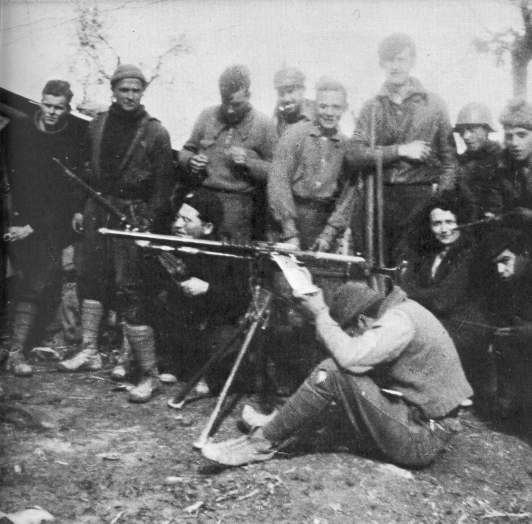
George Orwell (back row, 3rd from right) with the P.O.U.M, 1936. [Hoover Institution Archives]

Despite not being an active war correspondent during the Spanish Civil War, Orwell’s reportage Homage to Catalonia paints a vivid account of the writer’s experiences, not only amongst the Marxist militias on the frontline against Franco, but also of the complicated political in-fighting that plagued the republican side. These experiences had lasting effects on Orwell who wrote in a letter to his friend Cyril Connolly "I have seen wonderful things and at last really believe in Socialism, which I never did before" 1 Orwell was wounded in the throat by a sharpshooter while at the front and shortly after his recovery had to leave Spain due to the forceful dissolution of the militia armies in favour of the international brigades. Upon returning to Britain Orwell was angered by both the left-wing press as well as the right for their continued distortion of the truth of the conflict he’d seen first hand - in New English Weekly in 1937, he wrote:

“…in spite of all those hecatombs of nuns who have been raped and crucified before the eyes of Daily Mail reporters, whether it is the pro-Fascist newspapers that have done the most harm. It is the left-wing papers, the News Chronicle and the Daily Worker, with their far subtler methods of distortion, that have prevented the British public from grasping the real nature of the struggle.” 2

Though Orwell is mostly identified with the last two great works of his life Animal Farm, and Nineteen Eighty-Four, it was his work as a journalist that he was known for during his life, and it was most certainly his reportage on the civil war that made his name as a polemic voice of dissent in the popular media. It was this sense of conviction, forged on the frontline of the Spanish Civil War, and so brutally re-assessed during the political upheaval in the republican side that followed, that planted the seeds of what would become his chilling vision of a future that still hangs over us today.

Hemingway (Center) in Spain, 1937. [jfklibrary.org - Public Domain]

Ernest Hemmingway’s most lasting commentary on the Spanish Civil War is the novel For Whom The Bell Tolls which follows the real events of the war through the personal experiences of an American named Robert Jordan, who fights for the Spanish Republic. While in Spain, Hemmingway wrote his reports for the North American Newspaper Alliance about the conflict. He would often turn a blind eye to any reports of atrocities committed by republican forces, and went so far as to lend his voice to the 1937 propaganda film The Spanish Earth. In a letter written to Carlos Baker in 1951, 11 years after the publication of For Whom the Bell Tolls, Hemingway wrote that “Politically, I was always on the side of the Republic from the day it was declared and for a long time before."3
Hemingway’s journalistic accounts of the action throughout the conflict are visceral in their descriptions, particularly in his reports of the shelling of Madrid, that was to secure the true horrors of war in the minds of his readers. His lexicon is technical and militaristic, yet the scenes described recall the literary flair seen in his short fictions that blurred the lines between reporting and literary narrative, such as in this dispatch during the siege of Madrid:

“During the morning twenty-two shells came into Madrid. They killed an old woman returning home from the market, dropping her in a huddled black heap of clothing, with one leg, suddenly detached, whirling against the wall of an adjoining house.”4

Hemingway’s obsession with all things Spanish had begun in the late twenties when he first experienced the spectacle of Bull fighting. But it was his civil war experience that was to drastically effect not only his political and religious beliefs for the rest of his life, but also go on to effect the world view of the next generations with For Whom the Bell Tolls - securing the sacrifice for the second Spanish Republic as the last great noble cause in the minds of many people around the world.

Gellhorn in Spain, 1937(?) [jfklibrary.org - Public Domain]

Martha Gellhorn is perhaps, one of, if not the most important war correspondent’s of the twentieth century, having reported on nearly all the major world conflicts that took place during her journalistic career. During the Spanish Civil War, she was employed by Collier’s Weekly to provide accounts of the conflict. Where Orwell’s experiences in amongst the P.O.U.M had turned him against Communism (particularly the kind the featured Stalin as it’s figurehead), Gellhorn’s experiences documenting the progression of the war alongside Hemingway would lead her to remain a supporter of the Stalin-backed republican government for the rest of her life - in a BBC radio four interview she said “There was a conviction that Fascism was a horrible and bad thing, and that this was the place to be to fight it. And it was an absolutely unbelievable, noble kind of experience.” 5
Gellhorn’s journalistic output was more geared towards reports on the daily life of the people of Spain, particularly those in the besieged capital of Madrid. She conveyed the humanitarian impact of the conflict and has since been described as technically similar to Hemingway‘s dispatches, but more powerful because of their human interest angles - as in this extract from a dispatch written during the siege of Madrid two month’s after the previous one by Hemingway:

“Later, you could see people around Madrid examining the new shell holes with curiosity and wonder. Otherwise they just went on with their daily routine of their lives, as if they had been interrupted by a heavy rainstorm but nothing more”6

Gellhorn’s influence on war reporting not only made it acceptable for women to become correspondents, but also to look at the events of war from the point of view of the people they effected. In Hemingway’s dispatches the casualties of war were a matter of fact, but in Gellhorn’s the human suffering of the conflict elicited an empathic response in her readers that as a journalistic device is used today in combination with television footage of the people themselves.

The coverage of Orwell’s reportage and essays, Hemmingway’s dispatches and fiction, and Gellhorn’s humanitarian angles on the conflict, have all come together to form what we see as modern war reporting in all journalistic mediums. Before the Spanish Civil War, never had a conflict been covered from the point of view of the front line fighter, or non-combatants but now reporters embedded with troops and ‘real life under fire’ reports are now the staple of modern conflict coverage.

END

1469 Words


End Notes:
1 Sedgwick, P. George Orwell International Socialist? (1969) (http://marxists.org/archive/sedgwick/1969/orwell)

2 Orwell, G. Spilling the Spanish Beans. (1937) New English Weekly (http://netcharles.com/orwell/essays/Spanish beans)
3 From the Hemingway Collection quoted on http://www.archives.gov/publications/prologue/2006/spring/hemingway.html
4 Hemingway, Ernest. N.A.N.A Dispatch: 11 April 1937. White, William (Ed). By-Line: Ernest Hemingway (1970) London: Penguin Books. P. 2495
6 BBC Radio Four Interview with Nigel Ford. Bookshelf, 4th January 1990. (http://www.bbc.co.uk/bbcfour/audiointerviews/realmedia/gellhornm/gellhornm3.ram)
7 Gellhorn, M. High Explosive for Everyone, July 1937. From The Face of War (1998) London, Granta Books. P 21.


Releated Links:
http://en.wikipedia.org/wiki/Spanish_Civil_War
http://www.timesonline.co.uk/tol/system/topicRoot/The_Spanish_Civil_War/
http://www.netcharles.com/orwell
http://www.marxists.org/
http://blip.tv/file/413638/
http://blip.tv/file/413689/
http://www.pbs.org/wnet/americanmasters/database/capa_r.html
http://www.britishpathe.com/product_display.php?searchword=spanish+civil+war
http://www.magazinesandwar.com/en.html
http://orpheus.ucsd.edu/speccoll/swphotojournalism/
http://www.magnumphotos.com/Archive/C.aspx?VP=XSpecific_MAG.PhotographerDetail_VPage&l1=0&pid=2K7O3R14YQNW&nm=Robert%20Capa
http://www.newsreelarchive.com/
http://en.wikipedia.org/wiki/Ernest_Hemingway#Spanish_Civil_War
http://en.wikipedia.org/wiki/Martha_Gellhorn
http://www.bbc.co.uk/bbcfour/audiointerviews/realmedia/gellhornm/gellhornm3.ram
http://www.salon.com/media/1998/03/12media.html
http://www.ernesthemingway.org.uk/

Friday, 4 June 2010

This is a transferred post from my previous wordpress blog published on: Mar 16, 2009.

I'm doing alot of work that revolves around George Orwell at the minute - focusing mainly on his time during the Spanish Civil War and on his Journalism rather than his novels... Basically I picked the most academic looking module on my MA course options to break up the portfolios (and I'll still have a feature to do for it lol).

Anyway, back in 2003 it was the 100th birthday of Eric Arthur Blair (Orwell) and they had a night on BBC 2 dedicated to him (of course). During the night there were several programmes including the 1954 BBC live television play of Nineteen Eighty-Four starring Peter Cushing, AND this documentary called George Orwell: A Life in Pictures.

Basically it is full of mock photos, film, and audio footage of Orwell where an actor (I forget his name) recites parts of Orwell's essays.

http://www.youtube.com/watch?v=V4s9pdL7tpA


Thats the link to the first video and here is the you tube channel with plenty of other documentaries too http://www.youtube.com/user/Ge0rge0rwell.


Enjoy.

Imago Alchemae: Imago Mortis on Tumblr

 
Twitter Facebook Tumblr Flickr Red Bubble