Bookmark and Share
Showing posts with label Music. Show all posts

Saturday, 26 February 2011

“I left in love, in laughter, and in truth and wherever truth, love and laughter abide, I am there in spirit.” - Bill Hicks
On the 26th of February 1994, aged just 32 years old, William Melvin Hicks died from Pancreatic cancer. Bill Hicks, as he was commonly known, was a stand-up comedian whose satirical, visceral and philosophical humour generated controversy and acclaim in equal measures. But Hicks was much more than a simple comedian. He was a musician, a philosopher, a satirist, and to some, a prophet. Hicks never resorted to “Blue” humour, even his infamous “Goatboy” routine was based on a very real tradition of Greek myths about the half-goat God Pan. Instead he presented the world as he saw it to his audience complete with all of its hypocrisy, hate, apathy and mediocrity, and tried to show the world for what it really was… Just a ride.

Hicks was born to a typical Southern Baptist family in Georgia USA, and lived in different states within the American “Bible Belt” in his formative years. As a young teen he discovered the comedy of Woody Allen and Richard Pryor and began to perform routines with friends, first at school and then at local clubs. As Hick’s style began to evolve he would often be compared to the likes of Lenny Bruce and George Carlin for his offbeat tangents and politically charged rants. But there was always more that could be done. Hicks would experiment with drugs and alcohol, and chain smoke on stage. This gave his work a fevered energy akin to a punk rock show. Hicks style was intimate and confrontational. He would viciously shout-down hecklers and never sugar-coated a single thought. But as Hicks’ personal philosophy sharpened, so did the messages in his act. After he gave up doing drugs, he would take an unpopular pro-drug stance because, unlike a lot of people with an anti-drug stance, he had experienced first hand the beneficial effects of drugs like LSD Marijuana and Magic Mushrooms, as well as the bad effects. One of his most famous riffs was on the lack of these positive effects in news reports which only ever focus on morons that throw themselves off buildings while on acid.

“Today, a young man on acid realized that all matter is merely energy condensed to a slow vibration — that we are all one consciousness experiencing itself subjectively. There is no such thing as death; life is only a dream, and we are the imagination of ourselves... Here's Tom with the weather!” - Bill Hicks, ‘Revelations’ (1993)
Consumerism, society, religion, politics, philosophy, popular culture and (perhaps most importantly) Bill Hicks were all subjects ruthlessly deconstructed in front of his live audiences. A relentless pursuit of “The Truth” featured throughout his material which often meant cutting through the pre-conceived notions of his audience in order to lead them, not to his point of view, but to their own. In an episode of the BBC series ‘A Question Of Taste’, in response to the line of questioning regarding his act, Hicks repeated a comment he once heard from an audience member who stated “We don't come to comedy to think!”, to which he retorted “Gee! Where do you go to think? I'll meet you there!”. He questioned the alleged guilt of Lee Harvey Oswald in the JFK assassination as well as David Koresh in the conclusion of the Waco siege and other conspiracy theories to make the point that the “truth” that the media presents is just one version and that it isn’t, by any stretch, gospel.

In the seventeen years since Bill Hicks death little has changed. Though there are many comedians around today who are inspired by, and pay tribute to Hicks, few take the bold and lonely stance he once did. In the age of surveillance, instant information, the war against terrorism and international fraud dressed up as capitalism a man like Bill Hicks is perhaps needed more than ever. Even senior Labour Party MP Stephen Pound paid tribute to Hicks on the tenth anniversary of his death in the following early day amendment.

“That this House notes with sadness the 10th anniversary of the death of Bill Hicks, on 26th February 1994, at the age of 33; recalls his assertion that his words would be a bullet in the heart of consumerism, capitalism and the American Dream; and mourns the passing of one of the few people who may be mentioned as being worth [sic] of inclusion with Lenny Bruce in any list of unflinching and painfully honest political philosophers.” - Stephen Pound, MP: ‘Anniversary of the Death of Bill Hicks’ (EDM 678 of the 2003-04 session)’

It is easy to think that we lost Bill Hicks too soon and wonder at what might have been if he’d lived to see the Clinton-Lewinsky scandal, George W. Bush, 9/11, The Second Gulf War, and the election of Barack Obama. But he did leave us with words to help us look for our own truth in the world. Perhaps Hicks’ most resonating pearls of wisdom came at the end of his 1992 show ‘Revelations’, that was broadcast on Channel 4 in the UK, the words of which sums up the truth of life as he saw it.

“The world is like a ride in an amusement park, and when you choose to go on it you think it’s real because that’s how powerful our minds are. The ride goes up and down, around and around, it has thrills and chills, and it’s very brightly colored, and it’s very loud, and it’s fun for a while. Many people have been on the ride a long time, and they begin to wonder, “Hey, is this real, or is this just a ride?” And other people have remembered, and they come back to us and say, “Hey, don’t worry; don’t be afraid, ever. Because this is just a ride.” And we…kill those people. “Shut him up! I’ve got a lot invested in this ride, shut him up! Look at my furrows of worry, look at my big bank account, and my family. This has to be real.” It’s just a ride. But we always kill the good guys who try and tell us that, you ever notice that? And let the demons run amok? But it doesn’t matter, because it’s just a ride. And we can change it any time we want. It’s only a choice. No effort, not work, no job, no savings of money. Just a simple choice, right now, between fear and love. The eyes of fear want you to put bigger locks on your doors, buy guns, close yourself off. The eyes of love instead see all of us as one. Here’s what we can do to change the world, right now, to a better ride. Take all that money we spend on weapons and defence each year and instead spend it feeding and clothing and educating the poor of the world, which it would pay for many times over, not one human being excluded, and we could explore space, together, both inner and outer, forever, in peace.”
R.I.P


http://www.billhicks.com/

Saturday, 22 January 2011

I haven't added a serious article to the blog in a long time so here is one. It was originally part of my Masters portfolio that accompanied the Tor Marrock interview that has since been published on http://www.reflectionsofdarkness.com/. There was also a feature on concert photography done in the style of Digital SLR Magazine which I may post as well at some point.
The following is a report rather than an essay, and I have slightly expanded a couple of points and added pictures to make it an easier read.
Enjoy.


Neue Zeitschrift für Musik issue #35


Music journalism is agreed to have started as soon as the popular press (newspapers and journals), as we recognize it, came into circulation in the eighteenth century. The reporters and reviewers employed then were often professional musicians themselves such as Robert Schumann who founded the journal Neue Zeitschrift für Musik in 1834. At this time the subjects of the reportage and criticism were mainly operas and symphonies with “lower” forms of music such as traditional folk music, monastic music and vaudeville being regarded as common and not of interest to the upper class readers. This changed during the period of the Romantic Movement when interest in music became much more widespread and non-specialist publications began to cover more entertainment subjects with journalists who were not necessarily experts in the field.

Coverage of rock‘n’ roll and pop music as we know it today didn’t become widespread until the early 1960’s after the international success of The Beatles. At this time publications such as Melody Maker, Sounds, The NME, and Rolling Stone emerged ― sometimes first as small circulation fanzines, then as established publications. As John Harris wrote for The Guardian in 2009:

“The history of rock writing begins around 1966 when, with what was once mere "pop" being taken seriously, the American writer Paul Williams published a journal-cum-fanzine titled Crawdaddy, which aimed to bring to rock music the kind of cerebral writing long devoted to folk and jazz. Other currents were swirling around the more educated bits of the US counter-culture, among them the expressive precedents set by the Beats and the possibilities suggested by New Journalism.” 1

These new magazines not only covered and critiqued the artists and their output but also began to dictate the changes in music trends in. So much that Rolling Stone magazine began courting power with record labels for the public attention a cover feature could generate for a band. Music journalism soon became big business as cover features in influential publications came to be seen as stepping-stones for musical acts and their record labels.


In the 1970’s music journalism took its first steps back toward being controlled by the people as much as the wider media. In 1976‘punk’was, according to the late Malcolm McClaren, born and with it came the new wave of fanzines. This was a backlash against the commercialised and increasingly impenetrable world of mainstream music coverage that allowed fans of new genre’s such as punk to write articles and reviews and publish them via their nearest Xerox copier. One notable example, and for some the original punk fanzine, was Sniffin’ Glue by Mark Perry. The cut and paste 'DIY' nature of this fanzine soon spread and became a platform for writers such as Danny Baker, Mick Mercer and Tony Fletcher who would in the following years of the 1980’s take control of the established publications.


Sniffin' Glue issue #3 featuring The Damned


The punk ethic that was carried over from the scene’s fanzines into mainstream magazines such as The NME and Melody Maker in the 1980’s shook up the established idea of music writing. Critique and reportage had been the objective of the magazines for their entire lifespan thus far. But with the new wave of writers came the new wave of attitude. Tom Wolfe's "New Journalism" and Hunter S. Thompson's "Gonzo" styles incestuously mixed with deconstructionist literary theory and frank, opinionated personalities. Take for example this review of the Bauhaus single‘The Passion of Lovers’from The NME by Adrian Thrills, which simply states:
“The desperation of losers…”2

The idea of the music journalist as a somewhat glamorous entity who travelled the world to do drugs with bands and write about it wasn’t a new one ― Just ask former NME scribe Nick Kent. However the idea of a music journalist that told you that you were an idiot for liking a certain band or, more often, and idiot for not liking them was more novel. As Everett True recently summed up his late colleague Steven 'Swells' Wells as the “paradigmatic tastemaker critic”:


“[T]aste-maker critics are like gods […] Do the public really require―or even want―a faceless “meta” critic, the lowest common denominator of countless opinions, where all opinion is reduced to a mean average mark?”3


The late Steven 'Swells' Wells: "Tastemaker Critic"


This style of music journalism has since been mythologised in the popular consciousness. Across the Atlantic in the USA, Lester Bangs was pioneering his own brutally honest form of music journalism that initially found a home in the pages of Rolling Stone magazine and later Creem. Bangs' cerebral and incendiary style was again informed by the principles of "New Journalism" and "Gonzo" which has given his thirteen year career an "outsider" credibility. This has even led to him being portrayed in Almost Famous (2000) as a wise guru and mentor to the film's young and naive protagonist.

"Well basically I just started out to lead [an interview] with the most insulting question I could think of. Because it seemed to me that the whole thing of interviewing as far as rock stars and that was just such a suck-up. It was grovelling obeisance to people who weren't that special, really. It's just a guy, just another person, so what?" 4


Lester Bangs: Journalist with attitude.


The weekly music publication in the 80’s was transformed, taking the idea of artistic writing and running with it with many publications opting to take the reader into the discussion by engaging with them. The reader may not necessarily like what the writer has to say, but based on their experience of that writer's work they will have formed their own opinion. As a result the reader will be able to create further discourse because of it. Thus spreading the debate and keeping the sense of ‘fanzine-people-power’, as Petra Davies notes:
“This model’s imagined reader is willing to become engaged with what she reads, a participant by proxy in the cut and thrust of art-criticism, and, crucially, imagined as likely to disagree as to agree.”5

Suddenly the music press made a dramatic shift in the 90’s. The glossy monthly magazine grew as the format of choice and with it an objective ‘consumer review’ style of writing that reduced the artistic merit of albums to the level of the machines that played them. The mainstream music press systematically alienated those who had personally invested in it. The idea of a balance between a trustworthy rating system and writing that would attract more advertising became the basis for a new type of marketing system. The authoritative and sometimes incendiary critic was, as a result, toned down if not snuffed out altogether.

As the world-wide-web grew and connected to more homes in the late 1990s, the fanzine began to return to strength through the basic HTML coding of websites. Companies such as Geocities, Angelfire, and Lycos provided free web space and a ‘drag and drop’ interface that gave people the chance to create their own E-Zines. By the turn of the millennium E-Zines had become as slick as the mainstream print publications, but were not yet bound by the same rules. Advertising came, but not enough to qualify censoring the opinions of its critics. Many sites even featured forums where the readers could praise and blast the reviewers, or even do some of their own reviewing thus continuing the trend of stimulating debate into the digital realm.


The shift to web 2.0 has since provided even more scope for the websites. Wordpress and Joomla have become powerful content management systems that promote user interaction (and best of all they are free!). Cheap web space and domain names coupled with the explosion in professional and amateur blogs has created a system of critics on the pulse of the industry that has propelled bands into the mainstream media’s attention.
“A counter-culture of laptop-toting aural misanthropes has successfully (if not accidentally) managed to turn the music industry on its head. Suddenly indie is not so “indie,” and the counter-culture―like it or not―is not so “counter.” Ironically, the citizen journalism cult built on P2P file sharing and hipster snarkiness is driving the music business, not draining it.”6

The falling circulation of publications and decreasing revenues in recent years has meant that many titles have begun to switch over to the interactive and blog-based webzine format. In many cases using the website portion of the publication to compliment, enhance and sell the traditional print version. But is it too late for the mainstream media model in the face of digital expansion, or will the bloggers of today like the fanzine writers of the punk era, take over the current publications and shift focus once again?


 End Notes:
1. Harris, John. The Guardian. http://www.guardian.co.uk/music/2009/jun/27/music-writing-bangs-marcus  (June 2009)
2. Thrills, Adrian. New Musical Express. (4th July 1981), P31 - Full review.
3. Davis, Petra. Drowned in Sound. http://drownedinsound.com/in_depth/4137396  (16th July 2009)
4. DeRogatis, Jim. Perfect Sound Forever. http://www.furious.com/Perfect/lesterbangs.html (Nov 1999)

5. Davis, Petra. Drowned in Sound. http://drownedinsound.com/in_depth/4137396  (16th July 2009)
6. Wayne, Jim. Online Journalism Review. http://www.ojr.org/ojr/stories/071218wayne/  (18th December 2007)
 

Friday, 4 June 2010

This is a transferred post from my previous wordpress blog published on: Oct 10, 2008.


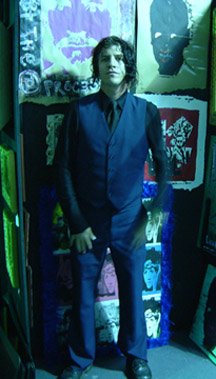
It has emerged that former Marilyn Manson and the Spooky Kids bassist and Unpop artist Gidget Gein has died.

Gidget (real name Brad Stewart) co-wrote many of Marilyn Manson's early songs and played on the 1994 debut album Portrait of an American Family. He is also credited as the main influence behind the early visual aesthetic of the band.

After being forced out of the band on the eve of the release of the album, Brad moved to New York and formed his own art-rock band The Dali Gaggers, and released one album; Confessions of a Spooky Kid. After moving back to his home state of Florida, Gein worked as a 'bag boy' for the coroner's office, which he recorded on his official website http://www.gidgetgein.com/.

 <A

He mended the bridge with former bandmate Marilyn Manson and appeared in the video for (s)AINT along with a sculpture (later bought by the video's director, Asia Argento) entitled In Case of Emergency Break Heart.

He moved to Los Angeles in order to further persue his Art and Fashion, and became a member of the Unpop art movement (alongside such notoraries as Boyd Rice, and Adam Parfrey). He was exhibited at a number of shows in the Hollywood area, and made his art available through his fashion line Gollywood. Gidget's art dealt with alot of themes common to the unpop movement - degenerate art thematically heavy with aspects of American pop culture now swept under the carpet. In 2006 he appeared as Detective Jeffery Mourir in the film Black Dahlia. In 2007 he released three new albums of music and recently began playing live again as part of the band People.


The one constant in Gidget Gein's varied and artistic life was his battle with drug addiction and on the 9th of October 2008, it was a battle he finally lost.


http://en.wikipedia.org/wiki/Gidget_Gein


* * *


I had communicated with Gidget numerous times via his personal myspace page and had always found him to be a wonderfully polite, smart, witty, and obviously a very talented person. As a fan and admirer I am deeply saddend by this news and my heart goes out to his friends and loved ones.

RIP GG

Imago Alchemae: Imago Mortis on Tumblr

 
Twitter Facebook Tumblr Flickr Red Bubble